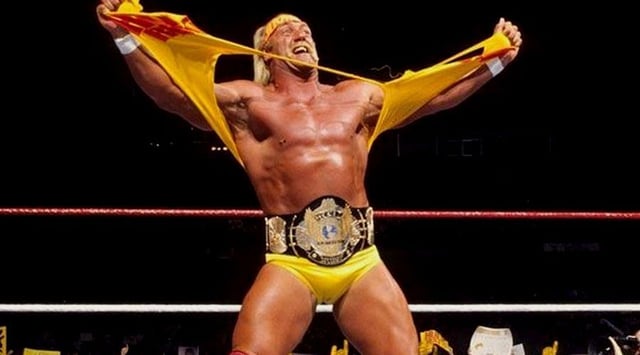
Today, Hulk Hogan — real name Terry Gene Bollea — passed away at the age of 71 after suffering cardiac arrest. Reports are still coming in, but early details suggest he may have been in declining health for days, possibly sedated and bedridden following complications from heart surgery. As someone who grew up idolizing Hulk Hogan and eventually became a pro wrestler myself, I feel like I’m mourning a myth while grappling with the truth.
This isn’t an easy post to write. Hulk Hogan wasn’t just a wrestler — he was wrestling to an entire generation. He was the face of the 1980s wrestling boom, the hero who told us to say our prayers, take our vitamins, and believe in ourselves. But Terry Bollea, the man behind the mustache and bandana, turned out to be something far more disappointing. Reconciling the legacy of Hulk Hogan with the realities of Terry Bollea has been a years-long process. Today, that conflict came to a head.
I was a child of the ’80s and ’90s. Hulkamania was larger than life — literally and figuratively. He slammed Andre the Giant at WrestleMania III. He crossed over into mainstream movies. He had Saturday morning cartoons, vitamins with his name on them, and T-shirts sold in every toy aisle. To millions of kids like me, Hulk Hogan represented strength, righteousness, and charisma.
As a kid, my first real hook into wrestling came from one particular moment. I was young, and I didn’t fully grasp that it was predetermined or fictional. It was on an episode of Saturday Night’s Main Event when Zeus—the late actor Tommy “Tiny” Lister—and Zeus snapped Hogan’s neck for The Million Dollar Man’s money, it felt terrifyingly real. I grew up in a religious household and wasn’t allowed to watch anything violent or crude. I remember sitting there, shocked. It was probably the first time I had seen something like that, and that sense of drama and larger-than-life storytelling pulled me in. It was like one of those 80s action movies I wasn’t allowed to watch yet—I imagined. I needed to see what would happen next. That moment ignited a lifelong love for wrestling that eventually led me to pursue it professionally myself.
Growing up, we didn’t have much. I vividly remember how I used to turn plastic grocery bags into makeshift Hogan tank tops. I’d cut off the bottom to mimic the shirts I saw on TV. I’d pretend I was in the ring, doing the poses, cutting promos, tearing them off like the Hulkster. It usually happened right after my mom went grocery shopping. Hogan represented more than just a wrestler. He was a symbol of strength, courage, and triumph. The escapism he provided was powerful.
Even in college, that connection stayed with me. One of my final papers was on subcultures and how they intersect with mainstream pop culture. Naturally, I wrote about professional wrestling, and specifically Hulk Hogan. I still remember getting a perfect score on that paper. My professor praised it for its insight into how Hogan’s image and appeal bridged the gap between fringe wrestling fandom and the global entertainment landscape. I might still have that paper stuffed in a box somewhere in the garage.
But as I grew older, and especially once I got into the wrestling business myself, my feelings about Hogan—Terry Bollea, the man—began to shift. Learning about who he was behind the character wasn’t easy.
In 2015, the world learned about Hogan’s racist remarks, captured on a leaked tape. He used the N-word multiple times and expressed disgust at the idea of his daughter dating a Black man. It was heartbreaking and infuriating. How do you reconcile the hero of your childhood with the reality of a man capable of such vile beliefs?
Then came the revelations about how he ratted out Jesse Ventura during efforts to unionize professional wrestling. Ventura, seeing how wrestlers lacked healthcare, retirement plans, or any real protections, tried to rally the boys in the locker room. And Hogan, aligning with Vince McMahon, exposed those efforts—preserving the system that still exploits wrestlers to this day. As someone who has worked the indie circuit and understands the financial, physical and emotional toll this business takes, that betrayal stings. I would even argue that if pro wrestling was unionized, the Chris Benoit story could have been prevented if Benoit had proper care. We’ll never really know.
And more recently, Hogan’s public support of Donald Trump—one of the most divisive and inflammatory political figures of our time—added another layer of disappointment. Aligning himself with a candidate who has openly stoked racial division and authoritarian leanings only confirmed a lot of the uncomfortable truths we were starting to suspect.
I chose to enter the wrestling business in part because of him. I performed in front of crowds, worked shows across the west coast, felt the energy of the fans, and lived my version of that dream. And part of that journey—whether I like it or not—was sparked by watching Hogan stand tall wearing the winged eagle belt with his hand to his ear, soaking in the cheers.
So, while some say Terry Bollea, the man, may not deserve our admiration, Hulk Hogan, the character, played a vital role in many of our lives.
It’s okay to hold both truths. To grieve the passing of a cultural icon while acknowledging the damage he caused. To remember the childlike awe he inspired while confronting the adult reality of who he was.
Wrestling is complicated. So are people. And today, I sit with that complexity. I guess I’m mourning the person I thought he was when I was a kid, but in reality that person died a few years ago.
What did Hogan mean to you? How do you reconcile childhood icons who disappoint? Let’s talk. Leave a comment, share a story. I’d love to hear from you.
 CharlesRamosOfficial.com
Leave a comment